

National Antivisection Society
Cataract lens replacement tested in fully human system
7 October 2010
Cataracts are cloudy patches in the lens inside the eye and are the main cause of impaired vision in the world, with an estimated 30% of over 65 year olds having cataracts in one or both eyes.
There are various risk factors for the condition, which include a family history of cataracts, smoking, poor diet and exposure to sunlight(1).
According to an article in the British Medical Journal, “cataract surgery is possibly the world´s oldest surgical procedure", being brought to Europe from India by the armies of Alexander the Great(2).
The only cure for cataracts is to remove the lens from the eye, which is done by either surgically removing the nucleus of the lens as a whole or by ultrasonically fragmenting the nucleus, which is then sucked out of the eye. The latter procedure requires a smaller incision, causes less inflammation post-operatively and rehabilitation takes 1-3 weeks, rather than 2-4 months for the former process.
Once the affected lens has been removed, it is replaced with an intra ocular lens (IOL). However, some lens´ epithelial cells still remain after the surgery. In approximately 25% of patients this leads to the development of Posterior Capsule Opacification (PCO), a condition where the epithelial cells spread across the visual axis of the eye. The design of IOLs can help prevent PCO, but current research into IOL designs is largely conducted on rabbits.
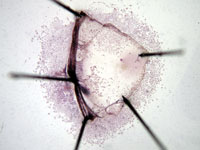
LDF sponsored research by Dr. Michael Wormstone at the University of East Anglia is using `eye bags´, from human donors, to carry out such tests. Dr. Wormstone recently established the optimum level of human serum in which to maximize cell growth on the lens. This was done by counting cell growth in tissue culture at varying concentrations of serum.
Once this was established, the first IOL was implanted into an eye capsule. An eye bag without an IOL was used as a control. The observations, to monitor any sign of PCO indicated by cell re-growth, were made using phase-microscopy. The IOL did slow the development of PCO, but did not prevent it completely; cells grew in sufficient number to cover the posterior of the capsule. Wrinkling of the capsule´s posterior also occurred, but less severely. In the human patient this would have resulted in impairment of the patient´s sight.
The initial IOL had round edges and it is known that IOL designs with a square edge are better at preventing PCO. Therefore, the next lens to be tested will be square-edged IOL which, if there is seen to be further retardation of cell growth, will provide further evidence for the use of the current model.

